How AI Changes Meta Ads Targeting and Creative Testing (Without Breaking Your Budget)
Aug 17, 2026
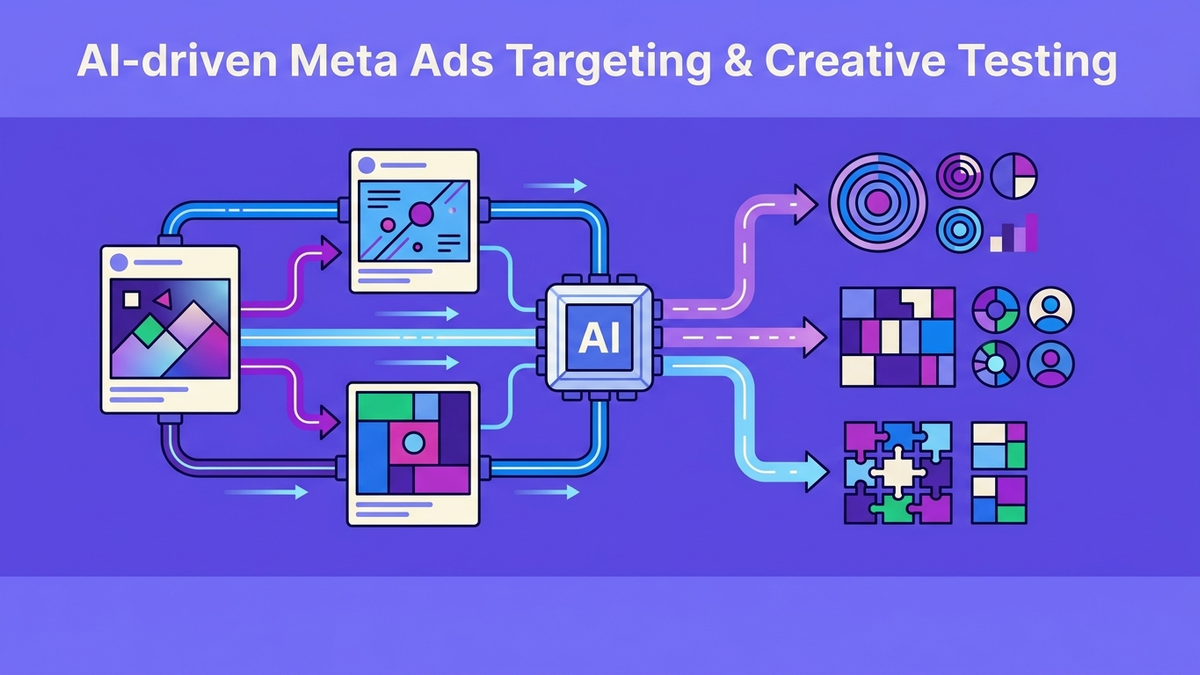
Meta's algorithm already does the targeting. So what's left for you?
Here's the uncomfortable truth: since Advantage+ and broad targeting became the default, most of the "targeting" levers marketers used to obsess over don't matter much. Lookalikes, interest stacks, detailed exclusions — Meta's system routinely beats them on cost per result when you feed it enough signal and enough creative.
Which means the real work has moved. Winning on Meta in 2026 is about two things: sending clean conversion signal back to the platform, and testing creative fast enough to keep the algorithm fed.
That's where AI actually earns its keep.
Where AI belongs in your Meta ads workflow
AI is not a magic targeting layer that sits on top of Meta and finds "better" audiences. It's an operator that handles the parts of the job that are too tedious, too fast, or too data-heavy for a human to keep up with:
- Deciding which creative to launch next based on what's already working
- Reading fatigue signals before CPM spikes
- Matching offline conversions back to ad clicks so Meta learns from real revenue, not just form fills
- Killing underperformers on a rolling window instead of once a week
Done right, this loop compounds. Meta learns from cleaner signal, your creative library gets sharper, and your cost per acquisition drops even if your ad spend stays flat.
Step 1: Feed the machine real revenue, not surface events
Most small teams optimize toward "Lead" or "Add to Cart." Then they wonder why Meta keeps serving cheap leads that never close.
The fix is to push closed-revenue events back through the Conversions API. If a lead becomes a $4,200 customer 18 days later, Meta needs to know — and it needs to know which ad, which creative, and which click started the chain.
This is where a CRM that talks to your ad accounts natively (Plyto handles this in the same loop it uses to score leads) beats a stitched-together stack. When ad performance and pipeline live in one system, you can optimize campaigns against pipeline value, not top-of-funnel noise.
A practical checklist:
- Send `Purchase` or `Qualified Lead` events with actual monetary value
- Include deduplication IDs so pixel and CAPI events don't double-count
- Backfill closed deals from your CRM on at least a daily cadence
- Pass first-party data (hashed email, phone) for match quality above 8.0
Step 2: Structure campaigns for creative testing, not audience testing
A good modern account structure looks boring:
- One or two broad Advantage+ campaigns for prospecting
- One retargeting campaign with a clean 30-day window
- Ad sets used mostly as containers, not audience experiments
The testing happens at the ad level. This is where AI creative tools change the math. Instead of testing three variants a week, you can generate and ship 20 — different hooks, different first three seconds, different captions, different aspect ratios — and let spend flow to whatever wins.
A useful rule: every new ad should differ from the control on exactly one axis. Same offer, new hook. Same hook, new visual. Same visual, new CTA. If you change three things at once, you learn nothing.
Step 3: Use AI to read creative fatigue early
Creative fatigue on Meta usually shows up as rising CPM and falling CTR about 7–14 days into a strong ad's life. Waiting until CPA balloons is too late — by then you've already burned budget.
An AI layer watching your account can flag fatigue before it hits your dashboard by tracking:
- Frequency by placement (Reels fatigues faster than Feed)
- First-second hold rate on video
- Comment sentiment shifts
- Rolling 3-day CPA vs. 14-day CPA
When those signals cross a threshold, the system should be queuing the next iteration, not waiting for a Monday meeting.
Step 4: Let attribution drive creative decisions, not just budget
Here's the part most teams miss. Meta's in-platform reporting will tell you which ad had the lowest CPA. Your CRM will tell you which ad brought in customers who actually stuck around.
Those are often different ads.
When you can see LTV, close rate, and sales cycle length tied back to the original ad creative, you start noticing patterns:
- Direct, problem-focused hooks pull higher-intent leads that close faster
- Aspirational hooks generate more volume but longer sales cycles
- Testimonial-style creative tends to attract better-fit accounts
Once you see it, you can brief the next round of creative with intent — not just "make more of the winner."
What a weekly rhythm looks like
A lean, AI-assisted Meta ads week for a small team:
- Monday: Review last week's ads by pipeline value, not just CPA. Kill anything below your revenue-adjusted CPA target.
- Tuesday–Wednesday: Ship 5–10 new creative variants against your current winner. One variable per test.
- Thursday: Check fatigue signals on top spenders. Queue replacements.
- Friday: Reconcile CRM revenue back to Meta via CAPI. Confirm match quality is holding.
That's it. No 40-audience test matrices. No weekly rebuild.
The point
Meta will keep getting better at targeting. Your edge isn't outsmarting its algorithm — it's feeding it the cleanest possible signal and out-iterating competitors on creative. AI is the leverage that makes both possible on a small team's schedule.
Get the loop tight, and the ad account starts to feel less like a slot machine and more like a system.
Plyto is the AI that makes and runs your ads
It writes the ad, builds the landing page, captures the leads and shows you which dollar came back. Try it free, no credit card.
Start free